
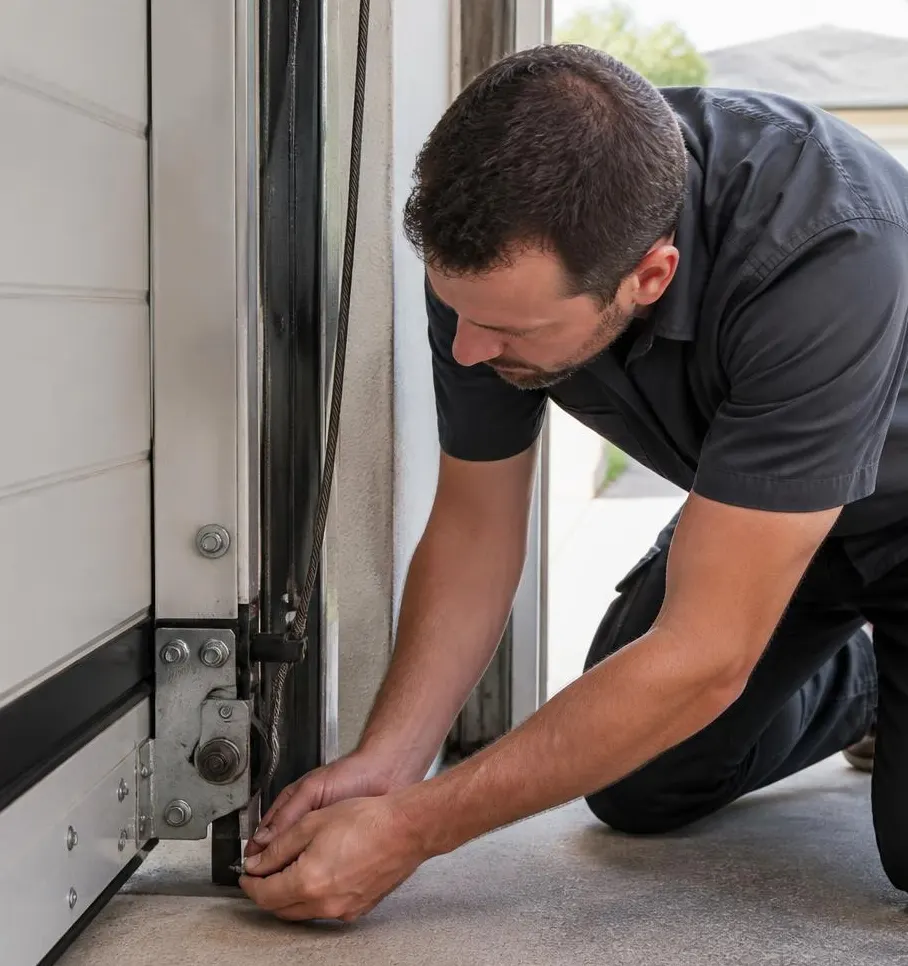
Most garage doors that suddenly stop opening are suffering from something small and electrical, not something broken and mechanical. The exceptions are loud: a bang from the garage followed by a door that won't budge even by hand usually means a spring let go, and a door that looks crooked or is stuck half-open after a storm usually means it's jumped its track.
Symptoms Worth Noting Before You Call Anyone
- Door hums or clicks but doesn't move — points to the opener motor or a stripped gear, not the door itself.
- Door is dead silent, nothing happens — points to power, the wall switch, or the remote.
- Door feels extremely heavy when lifted by hand — almost always a broken spring.
- Door opens a few inches then reverses or stops — often a safety sensor issue or a force-setting problem.
- Door looks tilted, one panel is lower than the rest, or it's jammed at an angle — off-track, usually from an impact or wind pressure.
The Order a Technician Checks Things
1. Power and the basics
Before touching tools, a technician checks whether the opener is plugged in, whether a breaker tripped, and whether the wall switch works even if the remote doesn't. In humid garages, condensation can build up on the safety sensor lenses near the floor, or afternoon downpours can splash water or spiderwebs across the beam. A misaligned or dirty photo-eye sensor is one of the most common reasons a door refuses to close or won't respond at all, and it's a five-minute fix: wipe the lenses, realign the brackets until the indicator light is steady instead of blinking.
2. Remote, keypad, and opener signal
Dead remote batteries, a keypad that's lost its code, or a Wi-Fi-connected opener that's dropped its network connection are next. These are quick to rule out and don't require a service call.
3. Broken torsion or extension spring
If the door won't lift manually and feels like dead weight, the spring has likely snapped. Springs are under heavy tension and are rated for a set number of open-close cycles; years of regular use, plus rust from Florida humidity working into the coils, both shorten that lifespan. This is not a DIY repair — the tension involved can cause serious injury. A technician replaces springs as a pair even if only one failed, since the other is usually close behind it.
4. Cables and drums
Next, the technician checks whether the lift cables have slipped off the drum or frayed. This often happens alongside spring failure, since the two systems work together, but it can also happen on its own from rust or wear.
5. Off-track rollers or bent track
A door that's visibly crooked or stuck at an angle usually has rollers that have come out of the track, or a track that's bent. In this area, that's frequently storm-related — wind-driven debris, a gust catching a door that was opening at the wrong moment, or impact from a vehicle. Steel rollers that have been sitting in a humid garage can also seize up and eventually force themselves out of alignment.
6. Opener motor, gears, and limit settings
If everything above checks out and the door still won't move, the issue is inside the opener itself — a stripped internal gear, a worn motor, or limit and force settings that have drifted out of calibration. Older openers in hot garages are more prone to this, since heat accelerates wear on circuit boards and internal plastic components.
A Seasonal Note
Going into hurricane season, it's worth checking that your door still closes fully and seals evenly along the bottom — wood doors can swell slightly with humidity, and wind-load-rated doors sometimes need their track and roller alignment reset after a storm even if there's no visible damage. If a door was forced open or closed during high wind, have it inspected before assuming it's fine.
When to Call Newberry Garage Door Service
If the door feels heavy, won't budge, or you hear a bang before it stopped working, that's a spring problem and it's time to call — our Garage Door Spring Repair covers torsion and extension springs, replaced in pairs, with the cables and drums checked at the same time. If the door is visibly crooked, stuck at an angle, or came off its track during a storm, our Off Track Door Repair gets the rollers back in line and checks for bent track before it causes further damage.
If your garage door in Newberry, FL has stopped opening, call Newberry Garage Door Service — we'll diagnose it on-site and get it moving again the same day.